"Irl we just kiss" / antitransmasculinity studies
'transmasc vs transfem' discourse & reactionary 'boys vs girls' politics in trans spaces

INTRODUCTION / TRANSMASCULINE ‘PICK-ME-ISM’ DEFINED
There is a dynamic that occurs as a part of antitransmasculinity that many people have been working to articulate, this being the instillation within trans men and transmasculine people (and anyone who is being perceived as a part of this group at the time) that the very concept of talking about things that harm these groups and creating language based around these experiences, that any mention of the intense and dire circumstances that many transmasculine people have suffered from or are currently suffering in — is really just an act of harm toward other queer and trans people, particularly toward transfems and trans women. More concisely put — there is a specific function of antitransmasculinity that teaches transmascs and men (+ those perceived as) seeking language to corroborate and combat their oppression is only done in order to redirect the focus from more marginalized groups, particularly trans women, so these discussions and attempts at formulating language are inherently harmful to trans women.
There have been more than a few cases of the transmasculine people who have been successfully indoctrinated into this line of logic being labeled “pick-me’s”, in response to statements like “if you think trans women hate you (a misinterpretation of ATM theory as it exists), it's probably because you actually suck to be around and not because this thing is real” or “trans guys who actually hang out with trans women know this isn't real and the trans guy who think its real never have any trans women around them”. “Pick me” is a term that is defined as derogatory slang used as an insult for someone “who acts against the interests of their own (typically marginalized) group in the hope of obtaining majority favor.” It is most frequently used when talking about misogynistic cishet women who enact misogyny against other cishet women in order to pander to misogynistic cishet men, and that’s where the phrase “he aint gonna pick you, sis” comes from. Simply put, it’s an insult stemming from the idea that a woman would throw other women under the bus to curry favor with the majority (in this case, the majority is misogynistic cishet men). This is also observed within the rhetoric along the lines of “we (transmasculine people) just have an easier time transitioning than trans women do” or “you have to admit you have male privilege” and “no transphobia happening to transmascs and men is ever specific to being a man, it’s just about being trans” — these are the transmasculine people who are most often labeled ‘pick me’s’.
MYTHS AND MISCONCEPTIONS
The reason I don’t like using this terminology to describe a dynamic that I do believe is real is because it is so often used as a way to position transfeminine people as the majority, and this is a myth many people have been working to debunk for a long time, that transfeminine people exist in vastly larger quantities than transmasculine people do. Though the people engaged in antitransmasculinity who similarly despite the use of “pick me” often disagree with it explicitly because they insist that saying the type of statements mentioned above don’t actually come with any rewards, unlike in the case of being favored by a majority like misogynistic cishet men, which does come with the rewards that come with being attached to someone who is seen as a patriarch in a patriarchal world. This is a fallacy however, considering the statements I reference are often being said and boosted by some of the most relevant, influential transmasculine people in trans academia + theory, who are seen authorities on transmasculine existence, behavior and oppression — people like Dr. Devon Price, author of widely sold “Laziness Does Not Exist” and “Unmasking Autism”. Devon Price frequently claims and boosts rhetoric that claims that transmasculine people exist in an inherently less persecuted and violated position in comparison to transfeminine people, that transmasculine people who speak up about antitransmasc violence (intracommunity or otherwise) are just sad, isolated, transmisogynistic baby transmascs who have never spoken to a trans woman before, that antitransmasculinity theory only exists as a counter to transmisogyny theory. He has stood by these statements and has been continually rewarded with even more reach, visibility, resource, credibility and leeway to continue to position himself as an authority on transmasculine existence and oppression as he avidly peddles rhetoric that directly harms transmasculine people. Nothing has been lost, only gained. And no, the 16 trans men who vocally disagreed on twitter does not count as something lost when the posts get 5 thousand or more likes and often get spread by activists with massive platforms because the source of them being people like Devon Price lends them credibility, something that the random transmasculine people who disagree with him are not able to leverage.
As with most forms of oppression, antiblackness finds a way to display itself and act as an essential force, as he has continually erased the fact that Black trans people of all gender expanses have been the primary people working to theorize antitransmasculinity, and that we have done so specifically to display how this oppression could not thrive without antiblackness. He, among many other influential trans (and cis) people, almost exclusively speak about antitransmasculinity theory when they come across the term being used by a transmisogynistic, bioessentialist white transmasc who happily calls themselves “afab” to signal innocence and “female socialization”. This act displayed by so many is both antitransmasculine and antiblack, as the constant erasure of the experiences of Black and Indigenous transmasculine people is a large factor in the continued invisibilization and lack of accountability for the violence and harm done to these demographics. There are countless other influential transmasculine people (and in turn, cis people who view them as an authority on things they themselves do not experience) who parrot these same sentiments, ignoring all input from racialized trans people who have continually beckoned them to see the flaws in their logic and how it consistently fails to take intersectionality into account, and how that is actively harming the people they believe their rhetoric is helping.
This obfuscation of truth and reality doesn’t matter much when punishment for pushing back on antitransmasculinity is framed as happening specifically to protect trans women and fight against transmisogyny, in spite of the fact that fighting antitransmasculinity and fighting transmisogyny are not in conflict with one another. The term of a transmasc “pick-me” exists not because of a belief that transfeminine people are the majority and/or that they are the oppressors of any other trans people, but because there are provable material rewards for upholding and platforming antitransmasculinity. I don’t agree with the term, and I don’t use it. I prefer to call people who participate in, uphold and platform antitransmasculinity what they are — antitransmasculine, regardless of the labels they use or identity they have.
WHAT IS ANTITRANSMASCULINITY? WHAT ISNT IT?
Before we go any further I’d love to explain exactly what antitransmasculinity truly is and what it represents to me, as one of the main people working toward establishing it as common vocabulary for those who need it to describe experiences or understanding of oppression. Firstly, antitransmasculinity does not exist to prove that it’s functions touch and/or harm transmasculine people exclusively — anyone can be touched or harmed by antitransmasculinity. It is more broadly meant to articulate how these things might specifically harm transmasculine people and those with manhood and/or masculinity as a part of their gender expanse. Things that are often labeled as antitransmasculinity happen to trans people who are not transmasculine, to nonbinary people, to cis people. There is no one goal of theorizing antitransmasculinity, but it is important to understand that it is not to explain that it does not happen to others, or that it exclusively happens to transmasculine people. However, it does extrapolate on how that harm is perceived by the outside world and what is actually done about it when the victims are transmasculine people, trans men, and trans people with masculinity or manhood as a part of their gender expanse, as harm does come to us all, but the reactions to it aren't always the same. If anyone tells you that antitransmasculinity only happens to transmasculine people and trans men, they are using the term incorrectly, and I would personally appreciate it if you would correct them. With the formation of new language to articulate specific experiences, comes misunderstandings, comes misuse, and I aim to continually work to make sure that this term is not misrepresented in it’s legacy, regardless of who attempts to rewrite the history of this term, regardless of whatever theory of transmasculine oppression might spur afterward.
Both intentional and unintentional misinterpretations of ATM theory are rampant, and difficult to keep track of as they come from so many different sources. The idea that antitransmasculinity exists as a theory to position transfeminine people as a part of an oppressor class is one big misrepresentation I see often. I do not, nor do any of the people (of all gender expanses) I know who write about antitransmasculinity, believe in the existence of sex-based oppression as it pertains to trans people. There is no harm that a trans person can perpetuate against another that places them into an oppressive class, as harm and intersectional analysis of power is far more complex than that. Antitransmasculinity is not a phenomena perpetrated exclusively by transfeminine people — this is another often spread fallacy, and something that I see brought up constantly in an effort to diminish credibility of theory and dismiss anyone speaking about antitransmasculinity. It often works, because well meaning non-transmisogynistic people don’t want to be a part of any discussion that begins with “transfems are to blame for x”, and that’s fair — but that is not what antitransmasculinity aims to present, and defining it as such is incorrect, and erasure of the theory that has been built.
The people who primarily uphold and perpetuate antitransmasculinity are cis men and women. Full stop. The perception that it is only transfems who are ever “called out” for ATM is largely due to the fact that antitransmasculinity is so normalized within trans spaces, and transmasculine people (and many many non transmascs! People who are also harmed by ATM!) have begun to widely push back on how normalized it is in an attempt to make trans spaces safer for themselves and others. This does not mean trans people are the primary perpetrators of it, but rather that trans people have a vested interest in making the spaces we inhabit safer for one another.
Personally, I focus so much on intra-community bigotry because I have an intense fixation with making sure that the spaces that yell to me “you are safe to be here” are actually safe for me. And they are not, when they are rife with constantly excused antitransmasculinity which is, as I have mentioned, often viciously laced in a heaping layer of antiblackness. Cis men and women are the primary disseminators of antitransmasc rhetoric — full stop. If you see someone blaming transfems exclusively for this phenomena, it is likely you have come across someone who spends most of their time within online discourse spaces who has internalized the visibility transfems receive in these spaces as being reflective of the entire world, when it is not and it is not representative of those of us who theorize on and push back against antitransmasculinity.
Antitransmasculinity as a term is meant to articulate experiences with oppression that largely stem from how we are perceived in the world, and that perception is not up to us as much as we attempt to control it, and that perception is not static, and that means it can happen to anyone.
So, this articulation of how specific harms are perceived and dealt (and often not dealt) with, a theory largely developed by Black and Indigenous trans people of all gender expanses is so frequently being defined as “early transition white tboys who want to feel special (who also hate (trans) women!)” is an act of direct devaluing of work, experiences and lives of the racialized people forming this theory which drives us further into invisibility, further trapped in cycles of harm.
The claim that “there is nothing that needs to be said [re: transmasculine oppression] that plenty of people haven’t already said, who have already said it in all the exactly right ways, that have come to all the exactly correct conclusions that benefit all the people who truly need it.” If this were the reality, so many people at so many different points of time, coming from so many different places, with so many varied gender embodiments would not continually find themselves attempting to develop language to articulate such specific harms manifesting in such unique ways. Harms that continually seem to find them in spite of the insistence that it should not have a name, the shadows of invisibility render it almost untouchable, immovable.
“The victim who is able to articulate the situation of the victim has ceased to be a victim: he or she has become a threat.”
― James Baldwin
4. PUNISHMENTS AND REWARDS
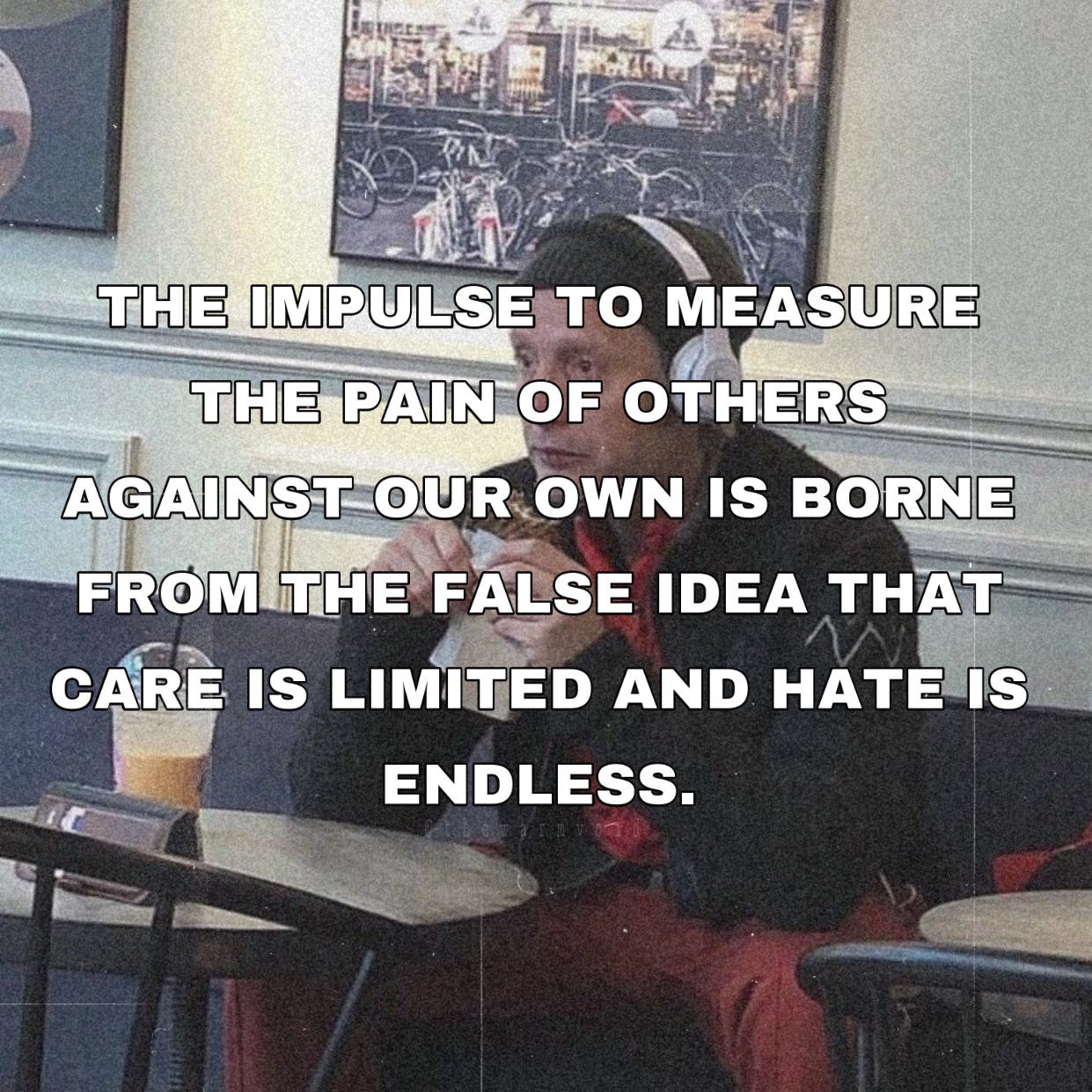
Something that makes this topic so complex is the fact that it is extremely personal, which makes it all extremely emotional. It’s hard not to have an emotional response to people saying things like “we [transmasculine people] have it tough, but they [transfeminine people] have it worse, it’s not taking anything from you to acknowledge that they have it harder, we as trans men have to admit that no matter how hard it is for us, it’s always harder for trans women. It’s okay to not be the most oppressed, it doesn't mean you aren’t suffering at all just because you have to admit trans women are always suffering worse than you are.” – this is a very clear push to convince other trans people that there is limited space in this world for both suffering and care. I promise you, there is an infinite amount of both in this world. I urge people to have sympathy for the reactions many transmasculine people might have to hearing things like “please understand your suffering is not something we should be making any more room for, asking anyone for this is bigoted” so consistently when we live in a time where the news of hate crimes , murders , sexual assaults and suicides are just as consistent in trans news, media and discourse cycles.
When I come across statements like that I have empathy for everyone involved, knowing there is a massive chance that this reaction [your/my/our suffering is secondary, less violent] is due to the belief that echoing these sentiments and teaching them to other transmasculine people is the right way [and sometimes even seen as the best way] to be an ally to trans women. The idea that dismissing and devaluing transmasculine oppression, violence and pain while actively advising other transmasculine people to treat their pain as secondary splash damage is how you show that you care.
I didn’t realize, until I was no longer surrounded by people who only accepted me as long as I kept my muzzle on tight, that I had made the pain and suffering that had been inflicted upon me a part of my humanity that could be explained away as merely accidental. I was vehemently rewarded for upholding antitransmasculinity, and declaring that any transmasculine person who didn’t subscribe to this line of logic was just, uhmmm, obviously not as much of a trans woman lover as I was. I was avidly rewarded for this denial of antitransmasculinity as an axis of oppression, particularly for denying the ability of queer and trans people to perpetuate it, and for punishing other transmasculine people [with verbal condemnations of implicit and obvious transmisogyny] who spoke up about it via shunning them as someone who simply doesn’t care about trans women or transmisogyny with the reasoning that attention on antitransmasculinity only existed as a foil to combating transmisogyny. I was rewarded in emotional care, with material resources, with visibility. During the time in my life where I turned a blind eye to the antitransmasc [ and thus, so often deeply antiblack ] actions of the people around me, I was given so much space in places that elevated me in profound ways.
I reflect on this time I spent being surrounded by people whose arguments largely centered around the fact that they have so little power, and I realize at the same time as they swore they had no power, I was, because of them, the closest I had ever been to escaping poverty just off the boosting and backing I gained from proximity to such influential white trans + queer people. I gained thousands of followers very quickly, not only because of avid posting but specifically from the endorsements of people who would later completely dissociate from me and condemn me for daring to unbuckle my muzzle. I regret this time in my life deeply. I apologize from the bottom of my heart to anyone I ever hurt with antitransmasc rhetoric, for boosting the words and theory of people who treat transmasculine pain as being in opposition transfeminine pain, to keeping the company of people who only saw and accepted my complex humanity as long as I refused to point out the way that they would continually disregard [or outright deny] the complex humanity of others.
5. THE ILLUSION OF CHOICE / ANTITRANSMASCULINITY & INTERSECTIONALITY
The thing is, caring about trans women, fighting against transmisogyny and advocating for transmasculine people and against antitransmasc sentiments + behavior, are not things that are in conflict with one another. If someone is representing either as being in conflict with the other, there is a reason for that, and it is not because that is true. There are a few reasons they are sometimes seen as being in conflict, and it is largely because so much of the conversations held by the people with the biggest platforms and most reach have exclusively represented antitransmasculinity theory as nothing but a counter to transmisogyny theory and transfeminism as a whole. These conversations nearly exclusively engage with antitransmasculinity theory in quick dunks and debunking threads based off of random anonymous twitter users with 54 followers making inflammatory posts. It’s easy to see caring about trans women and caring about antitransmasculinity as in conflict with each other if you are only ever exposed to those who define antitransmasculinity as a reactionary grab at attention that exists as inherently antithetical to transfeminism. That is not what ATM is, and in spite of the constant work that people are doing to erase this work and its intentions, it will never be that.
Care for trans women and advocating against transmisogyny is far more significant and visible in my behavior and praxis as someone who is engaged with ATM theory than it was in the days where I dismissed this harm that touches so many of us, transmasculine and not. I will go as far as saying that the things I did back in the day didn’t actually push back against transmisogyny in any meaningful way at all, things like telling transmascs to be quiet about their oppression, telling transmascs that they should accept taking a backseat because their suffering just isn’t that bad comparatively. I now see these words and actions as regressive behavior that harms trans people as a whole, that keeps us further away from sincere freedom, I don’t see any transfeminine people being housed, fed, protected, made any safer, nothing – from any of that. And ultimately, that’s what I care about. I’m trying to make survival easier for all of us in whatever ways that I am capable.
Combating antitransmasculinity and combating transmisogyny/noir are intertwined struggles. Both forms of oppression are reinforced by one another in constant loops. I am desperate to stop watching people be convinced that participating in and upholding antitransmasculinity is what fighting transmisogyny is, and my goal is never to convince people dealing with antitransmasculinity that fighting it means engaging in transmisogyny. It is not fighting transmisogyny to help cis people continue their mass burial of transmasculine people by upholding blatant antitransmasc lies like “terfs don’t target transmasculine people’’ — “terfs don’t want transmascs dead, they want them detransitioned” – simply tagging on “oh, I just mean they don’t target them as much” and pretending like that makes a world of difference in a society where trans people (ALL of us) are one-third more likely to be killed by a stranger than cis people are. I will feel responsible for combatting this rhetoric forever, as someone who accepted it and watched it lead to many transmasculine people admitting things to me like, “well, if the way that I exist and the space I inhabit is so harsh, and talking about the ways it affects me as a transmasculine person means that I’d be a verifiable transmisogynist who harms trans women, I would rather be dead.” This is, regardless of any level of denial or shifting the blame, where the belief that any mention of antitransmasculinity (or the other words people use to describe this phenomena including: transandrophobia, transmisia, transmisandry and more) makes someone an enemy to trans women leads a lot of people. And as much as people get angry at me for mentioning it — this is also a contributing factor for a lot of detransitioning within the transmasculine community, a part that we as queer and trans people have a role in contributing to, which means we also have the power to change it, which is why that matters.
I largely keep the messages I get that say these things private, because I know how so many would choose to represent someone expressing such big, heavy feelings that they are thinking of detransitioning (“oh, another afab terf detranser making life worse for trans women because people were mean to them”) but, it’s important to me because I want as many trans people to exist as possible, and I don’t want to enact, endorse or uphold anything that discourages any trans person from coming out or continuing to live their life as trans.
6. TRANS PEOPLE MUST LIVE FOREVER
A transmasculine person who has chosen to remain anonymous in this discussion that has agreed to having this quote mentioned, said to me the other day, in reference to the antitransmasculinity making its way through trans groups as acceptable, due to the perception that anyone who speaks about it simply does not care about trans women:
“I’m just considering detransitioning. I don’t want to harm anyone and I try my hardest not to but I can’t escape the feelings that me being a man is harming people. I just want trans women to be safe and if that safety is better felt with one less man then idk. It might be worth it. I’m autistic so I struggle to comprehend complex issues like this and at this point it just seems easier to take the path of least resistance.”
There are transmasculine people who are watching this and are being taught that the way they exist in their highest level of truth, harms trans women. They are being taught that lifting up their voices to express hurt is a slight. What are transmasculine people supposed to do when they cannot live as women, but the way that they do live, as transmasculine people, as trans men— is seen as an inherent threat to a group of people that they [largely, there are outliers in every group, I am not talking about self described separatists ever, who exist in every demographic] want nothing but community with and safety for?
Is the answer really just, ‘get over it’? If that is the case, it’s not a surprise that many transmasculine people cannot cope with that as the conclusion, the knowledge that their most honest embodiment is not seen as the vessel of joy it is, but is instead a threat because of transmasculinity they do not want to and/or cannot live without. The cases of people who detransition because they feel like this are impossible to know. I feel most of the people who do this likely shrink back into themselves and their lives [in whatever ways they can] and simply perform the most palatable acceptable version of trans allyship that exists, living with what they see as a gift [the perception of cisness to the outside world that abhors gender transgression], and that when trans women talk about being hurt by men and the patriarchy and by ‘tme trans people’, at least it’s not about them anymore. This shrinking is not the behavior of someone seeking to deflect from harm they caused, or could cause — this is the behavior of someone desperate for camaraderie and community and acceptance, desperate to find a place that isn’t telling them that the way they exist is still so different that it must be held at an arms length, out of fear of all that could be destroyed if they were let in.
I know that antitransmasculinity exists for so many reasons, and one is because when I see transmasculine people express these sorts of sentiments, there are always people eager to crawl out of the walls and tell them that they are weak for not being able to withstand this torment or that they are right to feel that way and should go ahead and detransition or kill themselves, or that if they could live with a detransition, that they were never really trans in the first place, so good riddance. This happens often. Too many times for me to put up all the sources or I would become buried in depression over it. If you don’t believe me, if you don’t believe them— it’s because you don’t want to believe this level of cruelty exists and that is your prerogative. But that doesn’t make it go away. Maybe you don’t want to accept that you may have had a part in this, or because you don’t care even if you have, or because you are someone who has been convinced that this harm is not significant enough to warrant any reflection or action. Maybe it’s because you’ve been taught that when you tell someone they are behaving in a hurtful way due to societally ingrained biases, you are actually telling them that they are wrong and bad and irredeemable and untrustworthy. That’s not what I’m saying, and I’m sorry if that’s what you’ve been taught. The only way things get better is when we admit that we can all do better, which means acknowledging the shitty stuff we’ve internalized and working to unpack it.
7. GIRL WOUNDS / BOY BRUISE
I have spoken extensively about how so often when an individual speaks about antitransmasculinity, there is a somewhat immediate assumption by the disagreeing parties, that the person making the statement is, themselves, transmasculine when this is frequently not the case, especially as time goes on and this terminology becomes more known. It proves many previously articulated points within ATM theory, seeing how eager so many people are to misgender and misrepresent transfeminine people and trans people of other gender expanses that are specifically not transmasculine, as being transmasculine, in order to represent this as an issue that only transmasculine people ever truly care about enough to discuss.
I feel terribly for every transfeminine person I have known who has been misgendered and degendered for the crime of advocating against antitransmasculinity, and for vocally caring about a function of oppression that has the very real ability to touch and harm us all. This act that happens so often is a prominent example of the ways that transmisogyny and antitransmasculinity are interconnected — the way that so many trans women have their genders revoked from them the second she does not agree with the way that some have decided is the only correct way to protect and advocate for them.
TERFS are seeing this all, attempting to capitalize on it, and often succeeding. Sowing division between groups of trans people is only good for them. We have to keep our sights set on the fact that transmasc and transfeminine oppression overlap. Our struggles are completely inseparable, no matter what theory has led you to believing that the way to care for your specific marginalized group is by seeing them as insulated from the rest. It’s a blatant lie that antitransmasculinity theory is made to drive transmasculine people away from transfeminine people. It has never been and will never be a separatist ideology. It is meant to unite us in the fact that while we are mistreated by society for different reasons, the harm is perpetuated against us for distinctly similar goals: make it as hard as possible for us to exist.
I fear, how often I see things like “trans men just have an easier time passing because T is stronger” echoed by transmasculine people, in an effort to show what a great ally to transfeminine people they are, knowing that this rhetoric of testosterone being soooOooOO much stronger and transmascs passing soOoOoOo much easier is born from TERF rhetoric that claims testosterone causes irreversible damage and should continue to be a scheduled drug [actually, should be further scheduled and harder to acquire, especially for ‘young girl’ (see: transmascs and men)] in which trans people have to jump through video game hoops to acquire. I ache watching privileged, passing white trans men peddle myths about transmasculinity because it is how they have been taught to be an ally to transfeminine people, because their erasure of transmasculine experience that is not theirs is seen as the norm when it reinforces the status quo. So many people have been taught that how you prove you care about trans women and transmisogyny is by restricting your ideas about transmasculinity and the transmasc experience to white perisex transmascs with the ability to access testosterone and the desire to pass as cis men, thus erasing the rest of this microscopic marginalized population that also happens to be the actual majority. I feel pained, deeply, that as I write this, so many transmasculine people have been convinced that the way they care for trans women is by telling other transmasculine people that there is no real reason for them to be afraid, that nobody is after them, that their pain is not much more than paranoid hysterics, that this desperation to have it acknowledged is simply a desire to push transfeminine pain into the darkness.
8. TO HEALING
What is there to do about this? Nothing much, honestly. I will continue to do what I have been doing, which is be someone who vocally fights antitransmasculinity, who works to theorize it’s functioning, and I will continue to do so in tandem with many transfems and other trans people who don’t fit into “transfem or transmasc” boxes, people who never see transmasculine struggle as in opposition with their own, those who see transmasculine struggle as their own struggle by the simple virtue of living in a world that seeks to see us all drown.
I will continue to uplift the trans women and transfems around me, and give gratitude to those who fight alongside me. I will continue to seek more perspective from all different sources. I will continue to make it a priority to deepen my understanding of intersectional [trans]feminism. I will continue to fight for all of us. I will continue to refuse to idea that support and advocation exists like a physical pie and that if I speak for one, that means I want someone else silent. I will continue to appreciate and elevate other transfeminine people around me who are vocal about how antitransmasculinity is real, and about how upholding it is not only a danger to all of us, but that upholding it is not something that makes us feel safe or protected as a transmisogyny affected people.
I’m sorry things are like this, and I’m sorry to any transmasculine person who is dealing with feeling like you don’t have a place because you can’t find the balance between advocating for yourself and being told that it makes you a danger to other trans people to do so. I lost a lot of people, a lot of opportunities, a lot of resources and a lot of confidence when I first began to speak on these things. I lost people who I thought would be in my life forever. Now, coming up on two years since I first began allowing myself to have a voice — I have relationships in my life that are more solid than what I once thought would be lifelong. I am surrounded by people, trans women, trans men, transneutral people, intersex trans men and women, all kinds of people — who see my advocation for transmasculine people as a beautiful part of me, as something to encourage.
I promise you, you’re not a danger to trans women for fighting against an oppressive force that seeks to harm them, too. I promise you, you will find plenty of people who will care for you as you speak about these things. I promise you will not drive all the women in your life away, trans or cis. I promise you, so much of the world is happy that you’re trans. I’m happy that you are. Silencing yourself when it comes to the suffering this world brings you, repressing your truth, rejecting your freedom to name your oppression — these are not the things that keep transfeminine people safe. The way we keep each other safe is by prioritizing one anothers safety, and nobody who tells you that you must shut your mouth about the harm that comes to you is doing that. I am sorry if you have been told that’s what you need to do to be accepted. I need you to know there are other options. I need you to know that the other options are not only “abandon the fight against transmisogyny, only care about other transmasculine people” vs “feel no attachment to transmasculinity at all”.
9. IRL WE JUST KISS
There are also cases where the reaction [from all types of people] to transmasculine people expressing pain they have suffered due to this kind of discourse and the sweeping generalizations being made about transmasculine people that sounds something like: “in real life we don’t talk about this, we all just kiss each other”, and this reaction is just as shitty as dismissing it entirely. It adds a dynamic of something that many trans people are intimately familiar with, that of the “please, I like you when you don’t speak and are simply something nice to look at”, the kind of reasoning that strikes the fear of being abandoned by loved ones into the hearts of many many trans people of all different gender embodiments. There is this weird dichotomy where we seem to understand that cis people can hate trans people and still have sex with them, and derive pleasure from our bodies but somehow this is erased when we address dynamics between one another. Plenty of transmasculine people who hold transmisogynistic beliefs can and do sleep with transfeminine people, and plenty of transfeminine people who hold antitransmasc beliefs can and do sleep with transmasculine people.
It is not helping anyone to pretend like “in real life” these problems do not exist and in real life we all just kiss, cause it’s not true and it creates a situation where transmasculine people feel like to express pain is to be a party-pooper, and to be an ally is to be happily sexually available with no regard for who perpetuates antitransmasculinity or not. Let's get one thing straight — anyone, transmasculine or transfeminine, who tries to position things like transmasculine people are the dominant category of people perpetuating transmisogyny or transfeminine people are the dominant category of people perpetuating antitransmasculinity is dead wrong. Cis people are the dominant category reinforcing both of these things. It is wrong to help them continue to get away with it by turning our sword onto one another or by pretending entirely like we do not uphold bigotry against one another, as this refusal to confront it weakens us as a unit. Contrary to beliefs that seem to be spreading, you can be fun and hot and sexy and make out with plenty of transfeminine people while also being a transmasculine person who talks about and advocates against antitransmasculinity. I know a ton of dudes in this very category.
So while yeah, its possible that in real life, some of us are just kissing each other, it’s also true that many of us are doing both – we’re acknowledging and working to combat one anothers oppression, and loving each other while we do it. It is also very possible that in real life the opposite is happening, and there is antitransmasculinity and transmisogyny being perpetuated in spaces that should be mostly free of them. ‘Irl we just kiss’ is a dismissal of this, and it’s not helpful for anyone. It mistakes attraction for allyship, something we sincerely cannot afford as a unit.
CONCLUSION(s):
Many people who read this essay will likely condemn those of us who refuse to silence ourselves re: antitransmasculinity and label transfeminine people in support of this work as “uncool”, “tenderqueers’’, “chronically online”, “pick-me’s” or even “not really a trans woman” and other things like that. I just want you to know that in a world hellbent on making sure each and every one of us is having the most traumatic time possible existing as trans — the most uncool thing you can do is be ambivalent to the suffering of other trans people, or position the desire to speak about their suffering as an inherent harm to you. I’m sorry if you are a transfeminine person [ or non transmasculine trans person] who has decided to speak up about these things and as a result have watched people turn the very transmisogyny they claim to fight back against you. I’m sorry if the people talking about how all they do is center transfems and transmisogyny in their praxis have punished you for standing up for your transmasculine siblings, for pushing back against something that harms all of us. I know far too many transfeminine people who have been punished with silent exile for this, slowly watching the people who used to support them distance farther and farther away. I am sorry that you have to deal with such hypocrisy.
I’m thankful to every person who reads my words. I have to reiterate often the intention in them, but there is room to misread and misrepresent anything, even the most articulate of writing. I beckon those who have an issue with anything I’ve outlined here to speak with me about it, as this is meant to be revolutionary criticism with the goal of unifying and advancing our thought, and our mobilization against a society that aims to strip us of all agency.
Suggested materials:
When Homeless Trans Men Face Violence, There Are No Places to Turn
There is a hidden epidemic of violence against transmasculine people